
Causes of Sciatica

When I sat down to write this article, the first thing that came to my mind was how many clients I see with sciatica are focused on treating their sciatic pain symptoms instead of identifying and addressing what brought about the condition in the first place.
For example -if you were diagnosed with a herniated disc and now are getting a sciatic type pain. Instead of just treating the symptoms of sciatica, it is necessary to find out what caused the disc to herniate to begin with. With that knowledge, we can also address the underlying cause of the sciatic pain - the disc herniation, and in that way we will help prevent the reoccurrence of similar problems.
Sponsored links
Five examples of conditions causing sciatica:
When patients refer to my clinic with a sciatic type pain, I start working to discover what underlying condition may be causing the sciatic pain. Here are five examples of conditions that cause sciatica that we commonly find.
-
Muscle imbalance. Muscle imbalances are a main cause of sciatica that I see in my practice - and this underlying cause needs to be addressed alongside the symptoms of your sciatica. What I mean by muscle imbalance is where poor postural habits or movement patterns have pulled your body and spine out from their normal position into “faulty” positions into what Physiotherapists call ‘dysfunctions’. Most people move around and live their life without ever being aware of the position their muscles and joints are in. If muscle imbalance pulls a muscle, joint or disc out of position it may over stretch or compress the sciatic nerve causing it to pain.
It is important that you and your therapist not only treat the impinged nerve, but also address the postural muscle imbalances that have developed - this will reduce the chances of your sciatica reoccurring. Again my common theme - Diagnosis is the key to a longer-lasting cure.
-
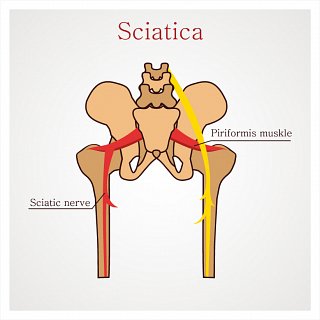
Piriformis Syndrome - A subset of the point above, this is a very common cause of sciatica arising from a tension or tightness in the piriformis muscle, which then places pressure on the sciatic nerve as it passes through the buttock resulting in pain. Indirectly, a tightened piriformis muscle will tend to pull the pelvis and hip out of alignment which may then also put a stretch pressure on your sciatic nerve, again causing pain symptoms.
-
Herniated disc - Sciatica can also be caused by pressure being placed on the sciatic nerve by a bulging or herniated disc. Disc herniations causing sciatica can result from falls, whiplash injuries or most commonly result over time from poor posture and its associated muscle imbalances. A herniated disc is where a disc bulges out between two vertebrae impinging in the case of sciatica on the sciatic nerve.
-
Spinal stenosis - is where there is a narrowing in the spinal canal at a particular level in the spine. If this stenosis occurs at the lower part of your spine where the sciatic nerves exits the back sciatica may result. Spinal stenosis can be caused by the aging process, trauma or it can be hereditary.
- Spondylolysthesis - is where one vertebra slips forwards relative to another. This, again, may cause sciatica as the bones impinge on the nerve. The cause of Spondylolysthesis may be hereditary, due to an injury or related to a type of bone disease.
So these are some of the main causes of sciatica that I see in my clinic. There are others, including Sacroiliac joint dysfunction and degenerative conditions such as arthritis, but rather than continue on in detail I want to get my main point across, which is that put simply, Sciatica is most commonly a reaction to a dysfunction in the lower back or pelvis. You and your therapist need to identify what that dysfunction is when you start your sciatica treatment.
Read more: Sciatica Treatment
DISCLAIMER
While the content and materials contained in the articles on this website have been written & researched by Sally Ann Quirke, a professional, practising & fully qualified Chartered Physiotherapist (Physical Therapist) based in Ireland, they are provided for general information and educational purposes only. They do not constitute medical advice on any particular individual situation. Please see your Chartered Physiotherapist or other medical practitioner for full and individual consultation.
Please read the full disclaimer here.
Cookies and Privacy
By using this website, you consent to the use of cookies in accordance with our cookie policy. For more information on how we use cookies, please read our cookie policy here.