
Piriformis Syndrome Treatment
Piriformis Syndrome Explained
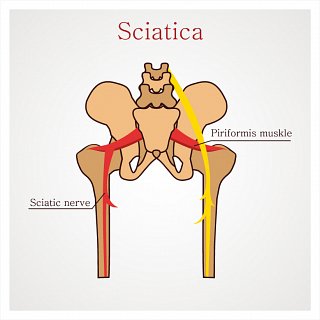
If you have pain, primarily in the buttock or hip area, then this could be symptomatic of Piriformis Syndrome.
The name sounds complicated, but put simply, it is tightness and dysfunction in your piriformis muscle, which then compresses and restricts your sciatic nerve.
Piriformis Syndrome is associated with sciatica and should be investigated as a possible cause of sciatica, particularly if the pain is in that lower back, hip and bum area.
What is the Piriformis Muscle
As I mentioned earlier, the condition is caused by an over active Piriformis Muscle. The Piriformis is a muscle runs across your sacrum, sacroiliac joint, pelvis and into your upper leg. It is one of the deep muscles within your buttock and the sciatic nerve passes close by.
In certain cases, the muscle can become ‘over active’, in other words, tight and tense. When this happens, the piriformis can compress the sciatic nerve and that is what causes the pain. The pain usually manifests itself as buttock pain or hip pain, but it can refer to the lower back or down the leg depending on how the piriformis muscle is affecting the sciatic nerve. Pain from the sciatic nerve is called Sciatica.
Sciatica can be caused by many things, piriformis syndrome being one such cause, particularly if the pain is in the bum or the lower back.
Why a correct diagnosis of Piriformis Syndrome is important
Diagnosis is the key to the long term resolution of sciatica. As always removing and managing the cause is the only successful treatment of buttock pain and sciatica. I believe many people are mis-diagnosed with the cause of their sciatica.
For example, I encounter clients who suffered from sciatic pain in the lower back / buttock area and have had MRI scans to their lower backs to investigate the cause, and from which disc degeneration has been identified. On many occasions they are told that their medical practitioner that sciatic nerve is being compressed by these discs and that is the cause of their sciatica. Despite treatment of the affected disc area, the pain persists and they have been referred to me.
On assessment their Piriformis muscle is overactive or tight causing their sciatic nerve to be compressed and their sciatic symptoms to be present. Once their piriformis muscle is released their symptoms disappear!
Why I mention this is to say that ultimately, scans are not always conclusive in providing a correct diagnosis of sciatic pain. It is possible to have a bulging disc that is asymptomatic - that is where disc bulge is not the cause of your lower back, buttock or leg pain. In such cases, Pirifromis syndrome is a common alternative and it is advisable to seek a physiotherapist assessment as to the cause of your sciatica as well as MRI scans. Doing this can lead to a quicker resolution of your symptoms.
So if you have a sciatic type pain, it is advisable to seek a Chartered Physiotherapist/Physical therapist’s opinion in your efforts to reach a conclusive diagnosis.
Piriformis Syndrome Treatment
Piriformis syndrome treatment always involves removing the cause of the pain, and in this case it is down to easing the dysfunction in the Piriformis Muscle. Its situation deep in your buttock pre-disposes it to tightness postural and movement patterns. Treatment usually involves specific exercises that stretch the piriformis muscle and postural correction exercises that re-strengthen the related weakened muscles around your buttock. A chartered Physiotherapist/physical therapist will advise you on this. Results usually occur within days and a following a home exercise programme is usually enough to prevent re-occurrence.
So, if you have a pain in your bum or upper legs seek early treatment! Get medical and physiotherapy advice to eliminate the possibility and cause of piriformis syndrome.
Sponsored links
DISCLAIMER
While the content and materials contained in the articles on this website have been written & researched by Sally Ann Quirke, a professional, practising & fully qualified Chartered Physiotherapist (Physical Therapist) based in Ireland, they are provided for general information and educational purposes only. They do not constitute medical advice on any particular individual situation. Please see your Chartered Physiotherapist or other medical practitioner for full and individual consultation.
Please read the full disclaimer here.
Cookies and Privacy
By using this website, you consent to the use of cookies in accordance with our cookie policy. For more information on how we use cookies, please read our cookie policy here.