
Ankylosing spondylitis
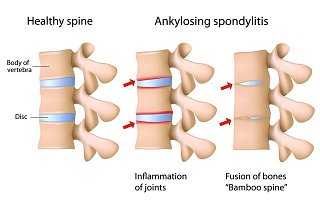
It can be very confusing - using words like spondylitis, spondylosis and spondylithesis to describe back pain, and when we start to put words like ankylosing, lumbar and cervical in front of them, then your head can really start to swim!
So let’s keep it simple and break it down a bit - ‘Ankylos’ (Stiff / Crooked) ‘spondylo’, (vertebra) ‘-itis’, (inflammation). Essentially, Ankylosing Spondylitis is a type of chronic inflammatory arthritis that mainly affects the joints / vertebra in your spine. It can be a progressive condition, meaning it gets worse over time. The progression may not be extreme. It may just result in stiffness in your spine, but at its worst it will result in partial fusion between two vertebra of the spine - known to many as a “bamboo spine”.
The causes of this condition are largely hereditary. A diagnosis is generally based on physical examination from your physiotherapist or doctor, probably followed by an x-ray of the spine and blood tests at the time of acute inflammation.
Unfortunately, like so many other forms of back arthritis, there is no known cure for this condition. Treating ankylosing spondylitis is normally based on management, which can be effective and allow you to be pain free. A combination of drug therapy for pain management from your doctor, and physiotherapy for mobilisation and strengthening exercises is my general treatment of choice.
From my perspective as a physiotherapist, the most important part of managing ankylosing spondylosis is to keep the joints above and below the affected joints mobile. Too often I see clients who come to me after years of medication, and unfortunately by this time the joints have stiffened so much that reversal can be difficult.
Sponsored links
Treating Ankylosing Spondylitis
So, as mentioned earlier, normally the treatment of choice involves keeping the affected joints mobile with physiotherapy mobilisation techniques, combined with keeping the joints above and below the affected area loose too. Following this, strength exercises to bolster the muscle groups around the affected joints also helps, as this will unload the joints and prevent excess pressure or strain that could lead to further damage. Pilates and adapted core strengthening exercises from a Chartered Physiotherapist who is well trained in the area is my recommended treatment pathway, for that is a very manageable condition.
DISCLAIMER
While the content and materials contained in the articles on this website have been written & researched by Sally Ann Quirke, a professional, practising & fully qualified Chartered Physiotherapist (Physical Therapist) based in Ireland, they are provided for general information and educational purposes only. They do not constitute medical advice on any particular individual situation. Please see your Chartered Physiotherapist or other medical practitioner for full and individual consultation.
Please read the full disclaimer here.
Cookies and Privacy
By using this website, you consent to the use of cookies in accordance with our cookie policy. For more information on how we use cookies, please read our cookie policy here.