
Spine Anatomy

It is important to understand your Spine Anatomy so that you can figure out the best approach to the treatment of your back pain and maintain a healthy back. If you have a back problem or back pain, then having a basic understanding of the anatomy of your spine is essential to help you understand how you can manage or cure your back pain.
Explaining the anatomy of the spine can be simple or difficult. In this article, I’m opting to make it as simple as possible - so here goes!!
We tend to think of our spines as a collection of interlinked bones - but there is a lot more to it than that…
Sponsored links
The Anatomy of the Spine Explained
The back is a complex machine and one of the most important components of your body. It provides the structure that enables you to stand, move, bend and twist. It also provides strong protection to your spinal cord, is the main pathway connecting your brain to your nervous system. But it is not just the 33 interlinked bones (vertebra) you have to consider when thinking about what your spine is - you have to also consider the ligaments, tendons and muscles that work all in conjunction with one another. Together they for part of the ‘spinal system’.

Here I will go through the parts that make up the spinal system: The Bones, discs, nerves, bones, ligaments and muscles.
Your spine is divided into five areas:
To start with, your spine is made up of 33 individual bones that are stacked on top of each other. These 33 bones are divided into five regions or areas:
- Cervical spine: Has 7 vertebrae known as C1-C7. This region runs from the stem of your brain down your neck
- Thoracic spine: Has 12 vertebrae known as T1-T12. This is the region of your upper and middle-back.
- Lumbar spine: Has five vertebrae known as L1-L5. Starts from below the shoulder blades down to your abdomen.
- Sacral spine: Has five fused vertebrae known as the sacrum. Is found in the lower back, and extends to your tailbone
- Coccygeal spine: Has four fused vertebrae known as the coccyx. The very bottom section of your spine.
So, when you hear a doctor or physio talk about your ‘lumbar spine’ or your ‘thoracic spine’, you will no know which area they are referring to. Now let’s take a closer look at an individual segment of the spine - the vertebra.
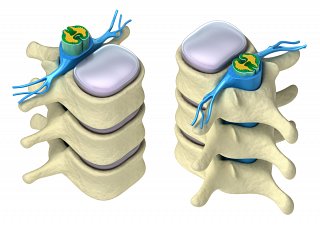
Each vertebra in your spine is a bone made up of:
- A main body known as the vertebral body.
- Pedicles of bone coming from both sides and the back of the body which in turn forms joints with their neighbouring vertebra.
Between each vertebral body lies a disc which acts as a cushion between the bones. Surrounding each vertebra are many ligaments, nerves, muscles and blood vessels.
It is the close-packed nature of each spinal segment that influences the severity of the symptoms that you can experience if any of the above structures is damaged or moved from its location. A common example this would be when a disc oozes a tiny distance from its centre and impinge on a nerve. This can result in the nerve transmitting a raging sciatic pain down your leg.
Getting to the source of your back pain
When clients present with back and/or neck pain to my physiotherapy clinic, we generally work together on isolating which of the following spinal structures are causing the problem:
- Discs.
- Nerves.
- Ligaments.
- Bones.
- Muscles.
Although each element has individual functions - and pain presentations - you may frequently experience symptoms coming from more than one structure, due to their close proximity to each other and interrelated function. The main focus is to get to the source the primary cause of your pain, and work to work treat the problem structure.
When the structures in your back become problematic or painful, often you will find that you hold yourself and move in an altered fashion. While you may start with good posture, this inevitably leads to poor postural habits which over time may result in further back or neck dysfunction. So, the alignment of your spine is crucial to your overall posture and movement patterns.
It is also important to say that each persons spinal anatomy may be different in small ways and in some cases, people are born with a slight anomaly in your spinal anatomy that may not be reversed but with good advice and back strengthening exercises should not cause you too much trouble after a while.
In summary, seek to understand the make-up of your back and neck as this will help greatly in the overall management of your back pain and neck pain.
Sponsored links
DISCLAIMER
While the content and materials contained in the articles on this website have been written & researched by Sally Ann Quirke, a professional, practising & fully qualified Chartered Physiotherapist (Physical Therapist) based in Ireland, they are provided for general information and educational purposes only. They do not constitute medical advice on any particular individual situation. Please see your Chartered Physiotherapist or other medical practitioner for full and individual consultation.
Please read the full disclaimer here.
Cookies and Privacy
By using this website, you consent to the use of cookies in accordance with our cookie policy. For more information on how we use cookies, please read our cookie policy here.